
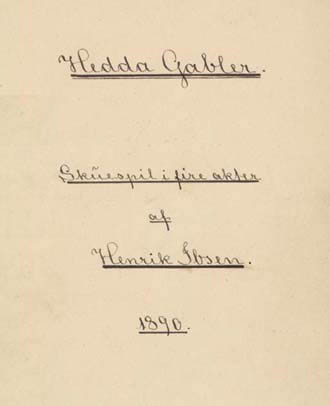
Hedda Gabler
Daughter of a general, trapped in an unwanted marriage.

via Wikipedia: Hedda Gabler · see source
Hedda Gabler is the title character of a play written by Norwegian playwright Henrik Ibsen. The world premiere was staged on 31 January 1891 at the Residenztheater in Munich. Ibsen himself was in attendance, although he remained back-stage. Though initial reviews were negative, it has since been canonized as a masterpiece of literary realism, 19th-century theatre, and world drama in general. The play dramatizes the experiences of Hedda, the daughter of a general, who is trapped in a marriage and a house that she does not want. Hedda is considered one of the great dramatic roles in theater, and has been described as a female variation of Hamlet.
- field
- Theatre
- nationality
- Norwegian
- known_for
- Title character of Ibsen's play Hedda Gabler; a masterpiece of literary realism
Verified Timeline
Lore & Background
Hedda Tesman (née Gabler) is the main character of Henrik Ibsen's play. She is newly married and bored with both her marriage and life, and seeks to influence a human fate for the first time. She is the daughter of General Gabler. On the subject of the title, Ibsen wrote: 'My intention in giving it this name was to indicate that Hedda as a personality is to be regarded rather as her father's daughter than her husband's wife.' Hedda's married name is Hedda Tesman; Gabler is her maiden name. The play dramatizes her experiences as she is trapped in a marriage and a house that she does not want. Hedda is considered one of the great dramatic roles in theater, and has been described as a female variation of Hamlet.
Reader's Guide
Hedda Gabler dramatizes the experiences of the title character, Hedda, the daughter of a general, who is trapped in a marriage and a house that she does not want. The play was first performed in Munich at the Königliches Residenz-Theater on 31 January 1891, with Clara Heese as Hedda, though Ibsen was said to be displeased with the declamatory style of her performance. In February 1891 there were productions in Berlin and Copenhagen. On 20 April 1891, the first British performance occurred at the Vaudeville Theatre, London, starring Elizabeth Robins, who directed it with Marion Lea, who played Thea. Robins also played Hedda in the first US production, which opened on 30 March 1898 at the Fifth Avenue Theatre, New York City. In February 1899 it was produced as part of The Moscow Art Theatre's first season with Maria F. Andreeva as Hedda. A 1902 production starring Minnie Maddern Fiske was a major sensation on Broadway, and following its initial limited run was revived with the same actress the next year. Many prominent actresses have played the role of Hedda, including Vera Komissarzhevskaya, Eleonora Duse, Alla Nazimova, Asta Nielsen, Johanne Louise Schmidt, Mrs. Patrick Campbell, Eva Le Gallienne, Elizabeth Robins, Anne Meacham, Ingrid Bergman, Peggy Ashcroft, Fenella Fielding, Jill Bennett, Janet Suzman, Diana Rigg, Glenda Jackson, Isabelle Huppert, Claire Bloom, June Brown, Kate Burton, Geraldine James, Kate Mulgrew, Kelly McGillis, Fiona Shaw, Maggie Smith, Jane Fonda, Annette Bening, Amanda Donohoe, Judy Davis, Emmanuelle Seigner, Mary-Louise Parker, Harriet Walter, Rosamund Pike, Ruth Wilson, Cate Blanchett and Katie Holmes. In 1970 the Royal National Theatre in London staged a production directed by Ingmar Bergman, starring Maggie Smith, who gained much critical acclaim and won a Best Actress Evening Standard Theatre Award for her performance. Also in the early 1970s, Irene Worth played Hedda at Stratford, Ontario, prompting New York Times critic Walter Kerr to write, 'Miss Worth is just possibly the best actress in the world.'
Did You Know?
- The world premiere of Hedda Gabler was staged on 31 January 1891 at the Residenztheater in Munich, with Ibsen in attendance back-stage.
- Ibsen wrote that he titled the play Hedda Gabler to indicate that Hedda is to be regarded as her father's daughter rather than her husband's wife.
- Hedda has been described as a female variation of Hamlet.
- The first British performance of the play occurred on 20 April 1891 at the Vaudeville Theatre, London, starring Elizabeth Robins.
- In 1970, Maggie Smith won a Best Actress Evening Standard Theatre Award for her performance as Hedda in a Royal National Theatre production directed by Ingmar Bergman.
Premiere and Critical Legacy
Henrik Ibsen's Hedda Gabler first took the stage on 31 January 1891 at the Residenztheater in Munich, an event that marked the world premiere of what would become a cornerstone of theatrical literature. Ibsen himself was present in Munich for the occasion, yet he chose to remain backstage rather than face the audience or the press directly. The critical reception at that initial showing was decidedly unfavorable; reviewers did not embrace the work with the enthusiasm it would later command. Over the ensuing decades, however, the play's reputation transformed dramatically. Hedda Gabler has since been enshrined as a masterpiece spanning multiple categories: literary realism, nineteenth-century theatre, and world drama at large. The work's Norwegian title carries a specific phonetic quality—[ˈhɛ̂dːɑ ˈɡɑ̀ːblər]—that anchors it firmly in its Scandinavian origin even as it has been performed and studied across the globe. What began as a poorly received evening in a Munich theatre hall ultimately secured Ibsen's place among the most enduring dramatists in the Western canon.
Hedda as a Dramatic Figure
The title character occupies a position of extraordinary weight in the history of the stage. Hedda, the daughter of a general, finds herself newly married and profoundly dissatisfied, trapped in both a union and a household she never truly desired. She craves luxury yet lacks the means, and she is driven by a desperate need to exert influence over another person's fate for the first time in her life. Critics and scholars have long drawn a parallel between Hedda and Shakespeare's Hamlet, describing her as a female counterpart to that iconic figure. Ibsen himself clarified his naming choice with a pointed remark: he intended the surname Gabler to signal that Hedda should be understood primarily as her father's daughter rather than her husband's wife. The literary critic Joseph Wood Krutch went further, identifying Hedda as one of the earliest fully realized neurotic female protagonists in all of literature. In Krutch's reading, she is neither rational in a conventional sense nor simply mad; her desires and actions follow a hidden, personal logic that makes her simultaneously comprehensible and terrifying.
The Architecture of Tragedy
The play's devastating arc turns on a single manuscript and a single pistol. Eilert Løvborg, a recovering alcoholic and former lover of Hedda, has poured his renewed creative energy into what he considers his masterwork. After losing the sole copy during a drunken episode at a party, the manuscript is found by George Tesman and brought home. When Eilert later tells Hedda and Thea that he has deliberately destroyed the text, Hedda offers no correction, even though Thea reveals it was their joint creation. Hedda then hands Eilert a pistol that belonged to her father, subtly encouraging him to end his life. She burns the manuscript, telling George she destroyed it to protect their financial future. The news arrives that Eilert is dead, but the circumstances are messy and probably accidental, occurring in a brothel—a far cry from the beautiful and free death Hedda had imagined. Judge Brack, who knows the pistol's provenance, uses this knowledge to threaten a scandal and pressure Hedda into a sexual relationship. Realizing she is utterly cornered, Hedda retires to her smaller room and shoots herself in the head. The others, hearing the shot, assume she is firing in the air before discovering her body.
The Ensemble Around Hedda
Hedda's world is populated by characters who each illuminate a different facet of her isolation. George Tesman, her husband, is a congenial academic whose devotion to research and travel blinds him to her manipulations; he remains a compassionate host even while competing for a professorship. His aunt Juliana, who raised him from early childhood, desperately longs for Hedda and her nephew to produce a child. Thea Elvsted, a nervous and shy former schoolmate of Hedda, has left her unhappy marriage to be with Eilert, and her gentle influence over him becomes a source of jealousy for Hedda. Judge Brack, an unscrupulous family friend, carries an implied lasciviousness directed specifically toward Hedda, and his knowledge of the pistol's origin becomes the instrument of her ultimate undoing. Eilert Løvborg, once in love with Hedda and now a recovering alcoholic, has destroyed his social standing through years of dissipation before Thea's companionship reignites his creative life. Even the servant Berte, who seeks to please Hedda at all times, underscores the web of dependency and control that defines the household in Kristiania.
Gallery





Frequently Asked Questions
What is Hedda Gabler?
Hedda Gabler is a four-act play by Norwegian dramatist Henrik Ibsen that follows a general's daughter who finds herself locked into a marriage and a household she never wanted. It is widely regarded as a masterpiece of literary realism in the theater.
When and where was Hedda Gabler first performed?
The play premiered on 31 January 1891 at the Königliches Residenz-Theater in Berlin. It was written by Henrik Ibsen and quickly became a defining work of the realistic stage tradition.
Who is Hedda Gabler as a character?
Hedda is the daughter of a general who marries into a life she never chose, leaving her trapped in a domestic world that feels like a cage. The role is often called one of the greatest dramatic parts in all of theater and has been described as a female counterpart to Hamlet.
How does the story of Hedda Gabler end?
After the manipulations she sets in motion unravel and leave her isolated, Hedda takes her own life with a pistol. The final act closes on her suicide, underscoring how completely she was unable to escape the life she had inherited.
Why is Hedda Gabler considered important in drama?
Ibsen's play is a cornerstone of literary realism and remains a central text in the theatrical canon. The lead role is routinely cited as one of the most demanding and rewarding challenges available to a dramatic actress.
More in Plays & Drama 1-18
Spotted an error? Know more?
This is a living reference — every entry is fact-audited, and reader corrections feed straight into our audit queue. Suggest an edit · See this site's audit record